
 By
By 
Have you ever found a t-shirt that you absolutely loved in a store only to find out the price was more than you would be willing to pay? Everyone has been there at some point in time; buying an expensive piece of clothing only to find it has pilled, shrunk, or lost its shape after two washes. The truth is that price is not always indicative of the quality of an item. Many brands charge high prices simply for their name and not necessarily because of the quality of the fabric or construction.
If you want to stop wasting money on “disposable” clothing you need to learn how to “read” a piece of clothing’s fabric before you get to the cash register. Here are three tests that you can conduct in the fitting room and have them completed within 10 seconds.
The “Quick 3” Tests To Test Quality In The Fitting Room
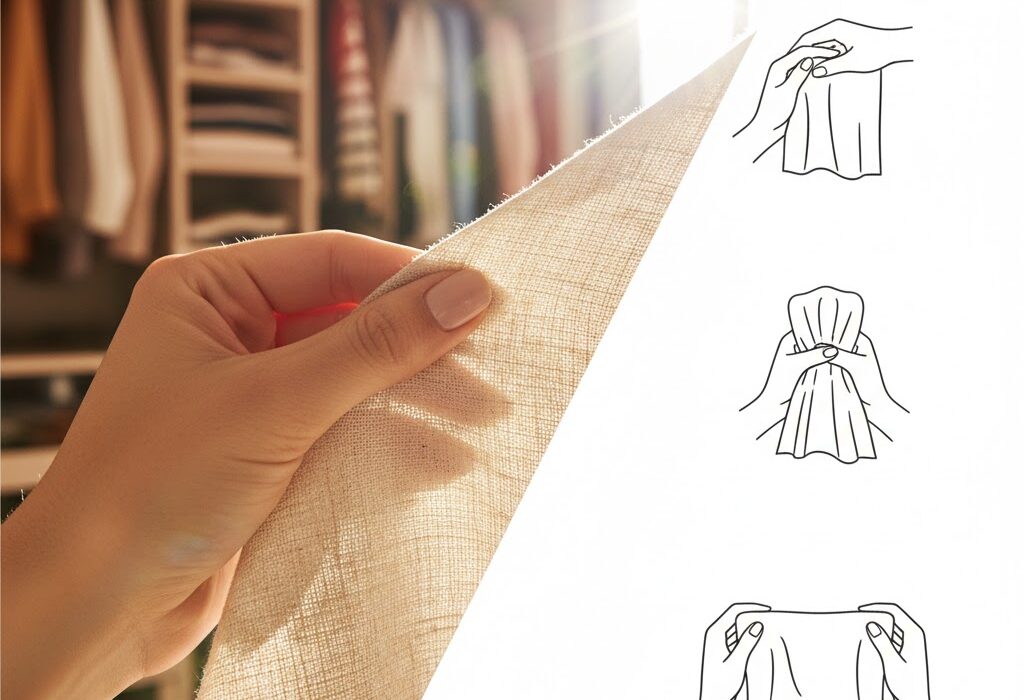
You don’t need to send your clothing to a lab to test for quality, you only need your two hands and take 10 seconds.
1. The Light Test (3 seconds)
Hold the item you are considering up to a bright light source. If you can see through the fabric (like summer linen, lightweight cotton) it is likely that although the item is thin, it will not be completely see-through.
High Quality: Tightly woven and/or dense fabric that prevents most light from coming through.
Low Quality: Fabric with gaps between the threads that resemble a “grid”; these will rip easily and/or lose their shape after a short time.
2: The Scrunch Test (4 seconds)
Take a handful of fabric and tightly squeeze it. Wait a few seconds and then release.
High Quality: The fabric should bounce back or have very little “natural” wrinkling.
Low Quality: If the fabric remains wrinkled like a piece of paper, it has likely been finished with inferior chemical starches. Once washed, it will lose its crispness, leaving you with limp, wrinkled fabric.
3: The Pull-back Test (3 seconds)
Gently pull and stretch a small part of the fabric. Release.
High Quality: The fabric should return back to shape immediately.
Low Quality: If the fabric is still slightly stretched out or appears to be wavy at the edge, the elastic recovery is poor and the fabric will sag after one use.
Signs That You Are Looking At “Cheap” Fabric
You don’t always need to rely on seeing through the clothing item itself; sometimes you can spot a bad piece of clothing just by using your senses.
Pilling on Hangers: In stores, any clothing piece with lots of pilling is going to be cheap. If you see little pills on something that nobody has worn yet, you can bet it will not hold up for long due to the short fiber lengths.
Plastic-like Appearance: A good piece of silk or cotton will have a natural luster. If it is shiny or feels like plastic, you can be pretty sure that the fabric is primarily polyester and not very good quality.
Uneven Dye: Look for discrepancies in the dye job; in particular, look for areas outside the sewing lines (the edges of joined pieces) or at the creases (the folds) where the colour appears to have been applied sporadically or unevenly. These issues indicate bad dyeing quality and will cause the colour to fade following the first soak of the clothing item.
Let’s Breakdown The Label & See Which Keywords Actually Matter
When looking at a garment, don’t just base your decision off of what brand it is; look to see the composition tag and look for the “Golden Keywords” to give you clues of how to better rank your blog and help people:
Long-Staple Cotton on your label will indicate that a longer fiber has been used to make the fabric softer and stronger than standard cotton.
GSM ( grams per square meter) will let you know how heavy the fabric is depending on what you’re looking to purchase, like 180gsm for a thick t-shirt or 120-150 gsm for a light summer dress.
Fabric blends aren’t always a bad thing! If you’re looking to retain shape, 95% Cotton with 5% Spandex/Elastane is far superior to 100% cheap cotton.
Conclusion: Shop with Your Hands NOT Just Your Eyes
While shopping in stores don’t get distracted by fancy mannequins and “Limited Edition” tags; take 10 seconds to lift the item (feel the weight), hold it up to the light and give it a quick scrunch. Buying quality fabric extends beyond being “fashionable” – it’s “Sustainable.” Buying quality clothing means less waste in landfills, saving you money in the long run & making you look better in clothes that last.
What one fabric do you always wish that you hadn’t bought? Tell me in the comments below!